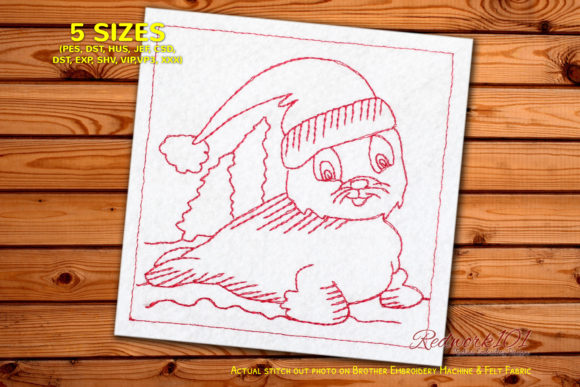
Christmas Ball with Christmas Tree
A Practical Design Review for Small Business Merchandise
As an embroidery designer who’s helped over 200 small businesses launch branded apparel, patches, and product accents, I approach every holiday design with two questions: “Will this hold up in production?” and “Does it strengthen the brand—not just decorate it?” When I first saw Christmas Ball with Christmas Tree, my instinct was to pause. The title suggests simplicity—but simplicity in embroidery is deceptively hard to execute well. This isn’t just a festive doodle; it’s a functional machine embroidery design intended for real-world business use across hats, tees, sweatshirts, towels, children’s wear, and more.
First Impression: Friendly, Festive, and Flexible
Christmas Ball with Christmas Tree reads as warm and accessible—not overly ornate, not starkly minimal. It leans into classic holiday charm without leaning on clichés like snowflakes or reindeer. That’s strategic. A café owner can embroider it on aprons without clashing with coffee motifs. A florist can pair it with green thread on natural linen tote bags. A pet boutique can scale it down for collar tags or holiday bandanas. Its visual personality sits comfortably between handmade product sincerity and small business merch polish—neither too rustic nor too corporate. That balance makes it unusually versatile for commercial embroidery projects.
Where It Shines in Real Business Use
This design excels where clarity, scalability, and emotional resonance matter most:
- Embroidered patches: With five size options built in, it adapts seamlessly—from 1.5" chest patches on staff uniforms to 3.5" back patches on boutique tote bags.
- Cap embroidery: The ball-and-tree composition fits naturally on curved front panels. Its compact shape avoids stretching distortion when digitized properly.
- Apron and work shirt accents: Positioned above a pocket or on a sleeve cuff, it adds seasonal warmth without overwhelming function.
- Tote bag design: Works beautifully centered on cotton canvas or jute—especially when paired with subtle thread contrast (e.g., forest green on cream).
- Customer gifts and event merch: Embroidered onto tea towels or kids’ sweatshirts, it feels intentional—not generic. That perception elevates perceived value.
- Etsy branding: As a consistent design asset, it supports visual consistency across listings, packaging accents, and printable mockups—reinforcing handmade credibility.
Where to Proceed with Care
Even strong designs have boundaries—and Christmas Ball with Christmas Tree is no exception. Here’s where attention matters:
- Small patch sizes: Below 1.25", fine details (like tree branch definition or ball highlights) may blur. Always test stitch-out at your smallest intended size.
- Curved surfaces and textured fabric: On knit caps or terry cloth towels, stitch density must be adjusted. High-density fills can pucker; looser fills risk looking thin.
- Dark uniforms and frequent washing: Choose high-contrast thread colors (e.g., white or gold on navy) and confirm durability through wash testing—especially for staff apparel.
- Thread color selection: Avoid low-contrast combos (e.g., light green on olive). The design relies on silhouette clarity—thread choice directly impacts recognition.
Impact on Brand Identity and Customer Trust
For small businesses, holiday embroidery isn’t just decoration—it’s a micro-expression of values. Christmas Ball with Christmas Tree supports authenticity because it feels intentional, not stock. When customers see it on a bakery’s apron or a craft studio’s tote, they register care—not just commerce. That builds trust. Consistent use across touchpoints (packaging tags, staff uniforms, social media mockups) strengthens visual recall. And because it avoids dated trends, it won’t look out of place next December—or even in January’s “holiday sale” follow-up.
Importantly, it doesn’t scream “mass-produced.” Its balanced proportions and clean outlines suggest thoughtful curation—ideal for brands positioning themselves as handmade, locally rooted, or creatively intentional.
Practical Designer Notes Before You Stitch
Before sending Christmas Ball with Christmas Tree to production—or offering it to clients—here’s what I always do:
- Test in black and white first: Remove color bias. Does the shape read clearly? Is spacing even? Does the ball visually anchor the tree?
- Check small-size performance: Resize to your smallest intended hoop size and simulate stitch density. Look for crowding, float issues, or lost definition.
- Review thread color contrast: Print a physical swatch on your target fabric. Digital previews lie—especially on textured or dark materials.
- Inspect spacing and underlay: Tight corners (like where the tree meets the ball) need proper underlay to prevent gapping on stretchy knits.
- Confirm stabilizer strategy: Lightweight tear-away works for stable wovens; cut-away or mesh is essential for towels, fleece, or baby clothes.
- Create a client-ready mockup: Use it in context—on a cap, apron, or tote—to show how it integrates into their existing design assets.
- Compare beside other assets: Does it harmonize with your logo, typography, or secondary patterns? Visual consistency starts here.
- Verify commercial licensing: Since this is a digital embroidery file marketed for custom apparel and small business merch, confirm usage rights cover resale, client work, and physical product branding.
Remember: The strength of Christmas Ball with Christmas Tree isn’t just in its holiday spirit—it’s in its readiness to serve your business. Whether you’re stitching 10 aprons for a local florist or scaling to 500 tote bags for an Etsy launch, this design earns its place by being both joyful and dependable. That’s the hallmark of a truly functional embroidery file—one that delivers on aesthetics, execution, and brand integrity.